

0
 Added By admsolarpower
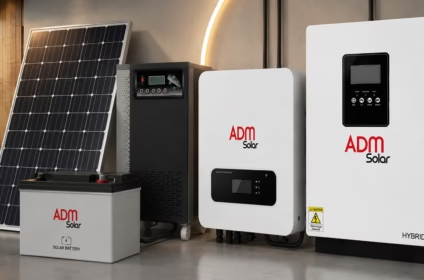
ADM Solar Power:Shaping World's Renewable Future With Smart Power Solutions
ADM Solar is one of the emerging solar panel ...
Petron Corporation is a major oil company providing petroleum products and petrochemicals, with operations that support daily fuel and industrial needs. In general terms, buyers looking for reliable energy and chemistry inputs can evaluate how refining steps like distillation, upgrading, and quality control affect end-product performance.
As a manufacturer category listing, this page focuses on how Petron Corporation describes its production flow—from crude sourcing and advanced refining to product processing, and then onward distribution to industrial customers and retail channels. Use the guidance below to understand the key stages that often matter when selecting petroleum and petrochemical supply: consistent processing, product specifications, and the ability to convert crude into multiple useful streams.
Petron Corporation presents itself as the largest oil company in the Philippines and a leading player in Malaysia. It describes its world-class petroleum products and petrochemicals that help fuel industries and everyday life. For procurement teams, this kind of positioning typically signals a vertically integrated approach: sourcing crude, refining it, processing outputs through additional units, and supplying products to both industrial customers and retail networks (as described on the company website).
When comparing manufacturers in the energy and petrochemical chain, it can help to review how raw inputs are converted into specific outputs such as LPG, gasoline, diesel, kerosene, and fuel oil, and how those outputs are further processed to meet strict quality and environmental specifications (as mentioned by Petron Corporation).
Petron Corporation describes operating one of the most advanced refineries in the region and sourcing most crude oil from the Middle East (as stated on its website). It also explains that crude oil is the raw material for products used daily, including LPG, diesel, and gasoline, and that it provides petrochemical inputs essential to manufacturing everyday goods.
General guidance for buyers: when you evaluate a refinery-to-market supplier, ask how their crude sourcing and refining configuration support stable output quality, especially for the product grades you need (for example, transportation fuels versus petrochemical feedstocks).
Petron Corporation explains a first step in processing crude oil: distillation or separation. Heat is applied so that lighter components collect at the upper part of a distillation column, while heavier components accumulate at the bottom. The lighter and heavier streams can then be routed to subsequent processing units to produce finished products and intermediates.
General guidance for buyers: distillation is only the beginning. If your end-use is sensitive to impurities or performance characteristics, focus on how each downstream stream is treated after separation.
Petron Corporation notes that raw intermediates undergo additional processes to meet strict quality and environmental specifications. For example, it explains that raw naphtha can be sent to a Reformer Unit, where a catalyst is used to increase octane number while producing LPG, gasoline, and reformate.
General guidance for buyers: confirm whether the supplier’s upgrading and treating steps align with your required product specifications (such as performance parameters for fuels or purity/grade expectations for petrochemical inputs).
Petron Corporation describes producing gasoline through processes that include upgrading of naphtha. It also describes reformate as being further converted into petrochemical feedstocks such as benzene, toluene, and mixed xylene. For diesel, it explains that production can go through a Hydrotreater to reduce sulfur content. It further describes how its diesel output is derived from this process and supported by an additives package, leading to improved acceleration, better fuel economy, and reduced emissions (as stated).
General guidance for buyers: if your application depends on emission-related or performance-related criteria, review the specific refining and treating steps used to target those outcomes.
Petron Corporation explains that fuel oil can be fully converted into higher value transportation fuels through “cracking” units, including Fluidized Catalytic Crackers and Delayed Coker. It also describes additional outputs from a Recovery Unit, which can produce more LPG and petrochemical propylene.
General guidance for buyers: if you need a portfolio of products from the same supply chain, ask how the supplier manages conversion flexibility and how it coordinates different unit operations to produce the required set of outputs.
Beyond fuels, Petron Corporation describes that reformate can be converted into petrochemical feedstocks such as benzene, toluene, and mixed xylene. It also describes conversion pathways that can generate other petrochemical-linked outputs, supporting industrial production needs.
General guidance for buyers: when ordering petrochemical feedstocks, it’s important to clarify grade requirements, allowable variability, and documentation expectations (for example, specification sheets and test results) so your downstream manufacturing processes remain consistent.
Petron Corporation describes transporting essential products to industrial customers and to its extensive retail network for fuels and LPG. It also provides information that, in the Philippines, it has a service station network and that it retails LPG through many branches nationwide (as stated on the company website).
General guidance for buyers: for industrial procurement, also evaluate distribution reliability—lead times, logistics readiness, and how the supplier routes product to the segments you serve (bulk industrial supply versus retail availability for end users).
If you’re assessing Petron Corporation for procurement, consider these practical checkpoints that align with what the company describes on its website. Treat them as general evaluation steps rather than guarantees:
Integrated oil and petrochemical manufacturers often provide value by combining crude sourcing, refining, conversion, and downstream distribution in a single operational ecosystem. Petron Corporation’s website describes a flow that begins with crude processing and includes conversion into fuels and petrochemical inputs used across industries.
For buyers, the goal is consistent outputs that can meet technical requirements. Even when specific performance outcomes depend on the product grade and testing standards, understanding the production stages—distillation separation, upgrading, hydro-treating, cracking, and conversion to petrochemical feedstocks—helps you ask the right questions before placing orders.
Bottom line: Petron Corporation is presented as a major oil company supplying petroleum products and petrochemicals. By understanding the refining and conversion steps described on its website—distillation separation, upgrading, hydro-treating, cracking, and transformation into fuels and petrochemical feedstocks—you can better evaluate whether it fits your manufacturing and procurement needs.
For faster login or register, use your social media account.



 Login with Google