

0
 Added By admsolarpower
ADM Solar Power:Shaping World's Renewable Future With Smart Power Solutions
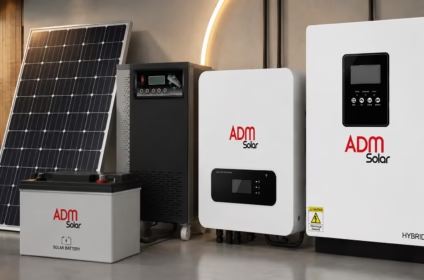
ADM Solar is one of the emerging solar panel ...
Sunways is a photovoltaic technology company founded in Konstanz, Germany in 1993. According to its public website, the company develops, manufactures, produces, and distributes photovoltaic parts and solar energy products, including inverters for on-grid and energy storage PV systems. Its listed product areas include on-grid inverters, hybrid inverters, batteries, accessories, data communication solutions, and applications for monitoring and managing photovoltaic systems. The company presents its work around the transition from fossil fuels to renewable energy, with a focus on solar power and energy storage applications.
The public source states that Sunways powers thousands of homes and businesses in more than 90 countries. Its solutions are described for residential, commercial, industrial, utility-scale, and energy storage use cases. The website also includes service and support areas such as downloads, warranty information, frequently asked questions, and global service. This listing is intended as a practical directory summary for buyers, installers, project owners, and energy professionals who want to review Sunways as a possible source for photovoltaic equipment and related support information.
Sunways lists several core product categories on its website. The on-grid inverter category includes utility-scale on-grid inverters, residential on-grid inverters, and commercial and industrial on-grid inverters. The hybrid inverter category is presented for energy systems that combine solar generation with energy storage. The battery category includes products described with capacities such as 5 to 20 kWh, 10 kWh, 5 kWh, and other configurations, with references to more than 6000 cycles, 90 percent depth of discharge, wall-mounted models, and stackable options. The website also lists accessories and monitoring as part of the product ecosystem.
The company describes residential solutions for household photovoltaic power stations, including residential roofs, farmers’ roofs, villas, sun rooms, and communities. The source text says Sunways household solutions are connected with efficient power generation, safety, and reliability. For commercial and industrial projects, the website refers to factory roofs, supermarkets, office buildings, and public building roofs such as colleges, hospitals, and stations. These types of sites can have large roof areas, significant electricity consumption, and project conditions that may differ from smaller household installations.
Energy storage is also a listed solution area. The source states that energy storage systems can be applicable in several scenarios, especially areas with unstable or unavailable grids, areas with significant price differences between peak and valley periods, and areas with high electricity prices. This public description indicates that the company positions storage not only as a backup option, but also as part of broader energy management, self-consumption, and cost-control planning. Buyers should still confirm final suitability with a qualified solar professional, because system design depends on local rules, electrical loads, roof conditions, utility requirements, and project goals.
Sunways presents on-grid inverters for grid-connected photovoltaic systems. In a typical solar project, an on-grid inverter converts direct current from PV modules into alternating current that can be used by the building or exported according to local grid rules. The company website separates on-grid applications into residential, commercial and industrial, and utility-scale categories. This separation is important for buyers because different project sizes generally require different voltage ranges, phase configurations, monitoring approaches, and installation standards.
Hybrid inverters are also part of the listed product range. In general buyer terms, a hybrid inverter can support solar generation together with battery storage, allowing the system to manage energy from panels, batteries, loads, and the grid depending on design and configuration. The Sunways source specifically connects its work to energy storage PV systems and lists hybrid inverters among its solar solutions. Project owners considering hybrid systems should review battery compatibility, backup requirements, grid-code requirements, available monitoring functions, and whether the final installation is intended for self-consumption, backup operation, peak shifting, or another purpose.
Battery products appear prominently in the scraped product navigation and image list. The source includes names such as STE-MS10, STE-OS 5~20kWh, STE-MS5, STE-NS16, STE-BS 5-20kWh, STE-ES 5-30kWh, and STE-FS 10-50kWh. The public product snippets also mention examples such as 5~20kWh, 10kWh, stackable models, wall-mounted models, more than 6000 cycles, and 90 percent DOD. These details should be verified against the current product datasheet before purchase, because capacity, certification, warranty terms, compatible inverters, and installation requirements can vary by model and market.
Sunways also lists accessories, data communication solutions, monitoring, and management applications. These items can be important because modern photovoltaic systems depend not only on the core inverter and battery hardware, but also on communications, safety equipment, configuration tools, data visibility, and service access. Monitoring can help owners, installers, and maintenance teams observe energy production and system status. Before choosing any monitoring or communication component, buyers should confirm the intended platform, supported network options, user permissions, alert functions, data retention, and compatibility with the selected inverter and battery configuration.
For residential customers, Sunways positions household photovoltaic solutions around rooftop power stations and home energy needs. A residential buyer may be interested in on-grid solar for self-consumption, a hybrid system for battery integration, or a storage solution where local electricity pricing or grid stability makes storage attractive. The public source mentions residential roofs, farmers’ roofs, villas, sun rooms, and communities as examples. Practical evaluation should include available roof area, roof orientation, shading, structural condition, local permitting, grid interconnection rules, system capacity, and the household’s daily electricity profile.
For commercial and industrial customers, the source describes factory roofs, supermarkets, office buildings, and public building roofs. These projects may require more detailed planning because electricity consumption, load curves, roof access, maintenance scheduling, and safety requirements can be more complex. Commercial and industrial buyers should ask for product datasheets, installation manuals, single-line diagrams, compliance documentation, monitoring details, service processes, and warranty terms. They should also evaluate whether the inverter capacity, MPPT configuration, voltage range, environmental rating, and communication options match the proposed project design.
Utility-scale projects are mentioned in the on-grid inverter category through the phrase utility-scale on-grid inverter. Utility-scale procurement often involves a more formal technical review, including grid-code compliance, plant controller requirements, testing documentation, environmental performance, operation and maintenance plans, spare parts strategy, logistics, and long-term service expectations. The Sunways public source does not provide a complete procurement package in the scraped text, so interested project developers should contact the company directly and request the latest model-specific documents, certifications, and regional availability details.
The public website includes several recent news and event references. It states that Sunways participated in the SNEC 18th International Photovoltaic Power Generation and Smart Energy Conference and Exhibition, SNEC PV+ 2025, in Shanghai from June 11 to 13, 2025, and exhibited updated solar inverter solutions at booth 4.1H-F370. The source also says Sunways presented products and solutions at Intersolar Europe 2025 at Messe München and at KEY – The Energy Transition Expo in Rimini, Italy from March 5 to 7. Another source paragraph refers to ENEX 2025 in Kielce, Poland.
The scraped source also states that Sunways announced IEC 62109 certification for its new STT-100-150KTL-SE inverter during Intersolar Europe 2025, with a ceremony attended by representatives identified in the source. This listing does not treat that statement as a certification of every Sunways product or of the company as a whole. Buyers should check the specific model, certificate scope, certificate number, issuing body, region, and current validity before relying on any certification for procurement, permitting, or grid interconnection.
The following guidance is general and is provided to help directory users evaluate photovoltaic equipment suppliers. It is not a claim that any specific Sunways product has a feature unless that feature is shown in the public source or confirmed in a current product document. When reviewing solar inverter or battery options, begin with the project type. A small residential roof, a commercial building, an industrial plant, and a utility project usually have different technical requirements. Clarify the required AC output, DC input range, battery capacity, mounting method, monitoring platform, grid connection rules, and service expectations before comparing products.
Next, request current datasheets and installation manuals for the exact model under consideration. Product family names and website summaries are useful for discovery, but procurement decisions should be based on model-specific documentation. Review electrical specifications, efficiency values, MPPT configuration, operating temperature, protection features, communication interfaces, enclosure rating, supported battery types, safety instructions, and required installation clearances. For batteries, examine usable capacity, nominal voltage, cycle claims, depth of discharge, operating temperature, expansion options, and whether the battery is wall-mounted, stackable, cabinet-based, or otherwise configured.
Confirm local compliance requirements before selecting equipment. Solar and storage systems may need to meet national electrical codes, utility interconnection standards, grid-code requirements, fire-safety rules, and local permitting conditions. The source mentions IEC 62109 certification for the STT-100-150KTL-SE inverter, but any buyer should confirm the current certificates for the exact product and destination market. Documentation should be checked directly with the manufacturer, distributor, installer, or certification database when possible. This is especially important for commercial, industrial, and utility projects where compliance documentation can affect permitting and commissioning timelines.
Assess monitoring and service needs early. A residential owner may want simple production visibility and alerts, while a commercial facility may require multiple user roles, exportable reports, remote diagnostics, and integration with existing energy management practices. The Sunways website lists monitoring and applications for monitoring and managing, so interested customers should ask what platform is available, whether mobile and web access are supported, how devices connect, what data is displayed, and what service channels are available for troubleshooting. Confirm whether monitoring accessories are included or purchased separately.
Consider warranty and support processes. The Sunways website includes a service and support area with downloads, warranty, FAQ, and global service sections. Before purchase, ask for the current warranty statement, claim process, response times, spare part availability, installer responsibilities, and whether support is handled directly or through a local distributor. Buyers should keep invoices, serial numbers, commissioning records, monitoring screenshots, and installation photos, because these documents are often useful if support or warranty assistance is later required.
For energy storage projects, define the operating goal before choosing equipment. Storage can be used for backup, self-consumption, time-of-use optimization, peak shifting, or operation in areas with unstable grids. The source states that energy storage systems are applicable in areas with unstable or unavailable grids, significant peak and valley price differences, and high electricity prices. A qualified designer should calculate the daily energy requirement, desired backup duration, inverter power rating, battery capacity, discharge limits, safety requirements, and charging strategy. Oversizing or undersizing storage can affect cost, performance, and customer satisfaction.
For commercial and industrial roofs, request a complete design review. The source mentions factories, supermarkets, office buildings, colleges, hospitals, stations, and other public building roofs. These locations can have different operating hours, safety constraints, access rules, load patterns, and structural conditions. A professional evaluation should include roof survey results, shading analysis, string design, protection devices, cable routing, fire access, monitoring location, maintenance access, and shutdown requirements. Where batteries are included, fire-safety separation, ventilation, environmental limits, and emergency procedures should be reviewed carefully.
For residential roofs, the same careful approach applies at a smaller scale. Homeowners should compare proposals based on system size, expected production, inverter type, battery capacity if included, monitoring features, product warranty, workmanship warranty, and installer experience. Sunways lists residential on-grid inverters, hybrid inverters, batteries, accessories, and monitoring, but the right combination depends on the home. A grid-tied system without storage may be appropriate for one household, while another household may prefer a hybrid system with battery capacity for energy management or backup planning.
The scraped contact source identifies the Sunways headquarter as NINGBO SUNWAYS TECHNOLOGIES CO., LTD. at No. 1, Second Road, Green Industrial Zone, Chongshou Town, Cixi City, Zhejiang Province, China, with phone 400-9922-958. It also lists Sunways Germany, SUNWAYS ENERGIE GMBH, at Darmstädter Landstr. 116, 60598 Frankfurt, Germany, with phone +49 (69) 310902702. Public email contacts found in the source include info@sunways-tech.com for sales, service@sunways-tech.com for service, and hr@sunways-tech.com for human resources. The official website shown in the source is https://www.sunways-tech.com/.
Because product availability, model names, documentation, support arrangements, and regional requirements can change, users should verify details directly through the official website or the relevant Sunways contact channel before making technical or purchasing decisions. This Lahatin.com draft is based only on scraped public data supplied for the listing. It does not add pricing, local distributor status, project references, awards, branch details beyond the addresses found in the source, or unsupported performance claims. It is designed to help visitors understand what Sunways publicly presents and to guide them toward the documents and questions needed for a responsible solar procurement process.
For faster login or register, use your social media account.





 Login with Google